BLOG |
Bitcoin LN 101
This guide explains what a seed phrase is, how it works under the hood, how to back it up and store it safely, and the common mistakes that cause people to lose their Bitcoin.


Bitcoin is moving toward self-custody, and so is Blink. As more users gain direct control over their own keys, one concept becomes essential to understand before anything else: the seed phrase.
If you hold your own Bitcoin, one thing matters more than your phone, your app, or your device: your seed phrase. Lose the phone and you can recover everything. Lose the seed phrase and the Bitcoin can be gone for good.
This guide explains what a seed phrase is, how it works, and exactly how to look after it. We start simple, then go deeper, and we end with the practical steps that actually keep your money safe.
Note: This article covers self-custodial wallets where you manage your own keys. If you use a custodial service like Blink's custodial wallet today, your account is protected by login credentials and account recovery — not a seed phrase. But as Blink introduces self-custodial experiences, understanding seed phrases becomes important for every user.
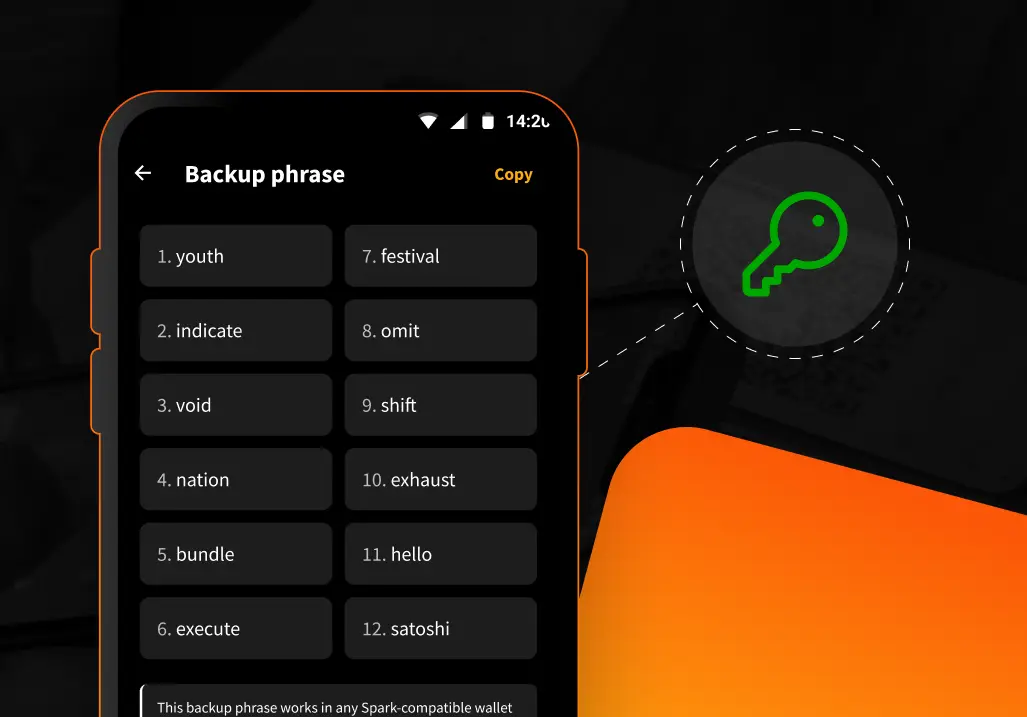
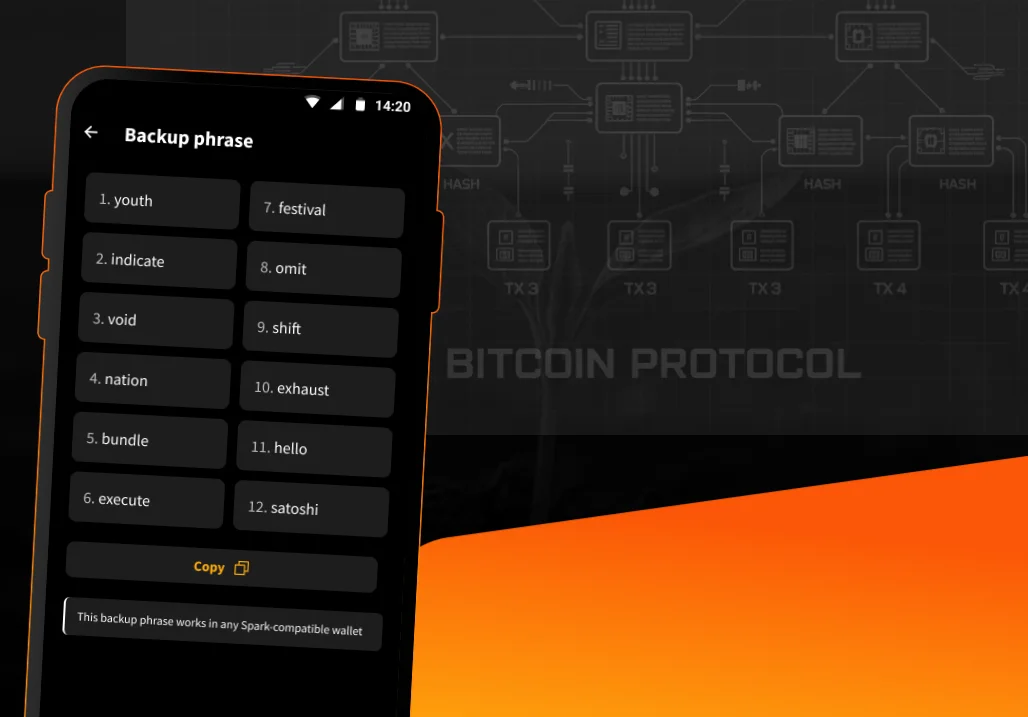
A seed phrase, also called a recovery phrase, is a list of random words, usually 12 or 24, that acts as the master key to your Bitcoin wallet. Your wallet generates it the first time you set it up, and it contains everything needed to restore your funds if your device is ever lost, stolen, or broken.
Here is the key mental model. Your Bitcoin does not live inside your phone or your wallet app. It lives on the Bitcoin blockchain. Your wallet is just the tool that holds the keys to it. The seed phrase is the backup of those keys. As long as you have the phrase, you can rebuild your wallet on any compatible app or device, anywhere in the world.
That is also why it must be protected. Anyone who has your seed phrase can take your Bitcoin. There is no bank to call, no password reset, no support team that can undo it. In a very real sense, the seed phrase is the money.
It is just a list of ordinary words, like this:
[dog] [egg] [fish] [stone] [lion] [yeast] [toad] [cut] [dance] [fence] [move] [eat]
Your wallet will display real words from the BIP-39 wordlist. We are not printing a real phrase here on purpose, even an "example" phrase could be misused if someone treats it as real.
The words come from a fixed list of 2,048 English words defined by a standard called BIP-39, which nearly every major wallet uses. Most phrases are 12 or 24 words, and each one is unique to the wallet that created it.
A detail that catches people out: the order matters. The words must be recorded and entered in the exact sequence they were given. The right words in the wrong order will not restore your wallet.
It is tempting to pick 12 memorable words yourself, but I recommend you don’t. There are two solid reasons.
For the same reason, never accept a "pre-filled" seed phrase from anyone or any website. A phrase someone else generated is a phrase someone else may have a copy of.
A 12-word BIP-39 seed phrase contains 128 bits of entropy. To put that into perspective, there are approximately 340 undecillion possible combinations (340 followed by 36 zeros). Even if a machine could test a trillion seed phrases every second, it would take far longer than the age of the universe to exhaust the possibilities. A 24-word seed phrase is even stronger, with 256 bits of entropy, making brute-force attacks effectively impossible with any technology available today and in the foreseeable future.
The wordlist is also smartly built for the real world. The first four letters of every word are unique, which helps with disambiguation; if your handwriting is rough or a letter smudges, the word can usually still be identified from those first four characters. This does not protect against missing words, wrong order, or damage to the beginning of a word, so careful recording still matters.
Want to understand why private keys matter in Bitcoin? Learn more in this excellent article: Not your keys , not your coin.
Many wallets let you add an optional passphrase, sometimes called a "seed extension," a "13th word," or a "25th word." This creates a two-factor backup: something you have (the written phrase) plus something you know (the passphrase). Both are needed to unlock the funds.
Sharp warning: if you forget the passphrase, the funds are lost, exactly as if you had lost the phrase itself.
A seed phrase backs up your deterministic wallet keys; the keys that control your on-chain Bitcoin addresses. That is its job, and it does it well.
However, a seed phrase alone may not back up everything in your wallet. Depending on your setup, the following may require separate backup:
The practical takeaway: always check how your specific wallet handles backups beyond the seed phrase. Follow the in-app backup guidance for your wallet.
For Blink non-custodial wallets, follow the in-app backup guidance. Recovery may require wallet-specific backup material, and Blink cannot recreate your secret recovery material for you. For details, check the Blink support resources.
Here is the part that actually protects your money. Follow it in order.
Learn these so you never repeat them.
Usually it's too late once you notice, but if you suspect anyone has seen, photographed, or copied your seed phrase (even partially) act immediately:
Speed matters. If an attacker has your phrase, they can move your funds at any time. Do not wait to "see if anything happens."
You do not need this section to use Bitcoin safely. But understanding it turns the seed phrase from a mysterious string of words into something you understand.
Behind those friendly words sits a large random number. When your wallet creates a phrase, it follows three steps defined by BIP-39 standard and laid out clearly by Learn Me a Bitcoin:
1. Generate randomness: The wallet produces an enormous random number called entropy. For example: 22519643896275707672877770571378163278. This randomness is the root of your wallet's security, which is exactly why it must come from your wallet and not from a human guessing words.
2. Turn the number into words: A short checksum is added to the entropy, the combined bits are split into groups of 11, and each group selects one word from the 2,048-word list. That is how raw randomness becomes a readable phrase.
3. Turn the words into keys: The phrase is run through a cryptographic function which produces master key. This key is then used to generate your addresses and send transactions. To learn more see: hierarchical key derivation as defined by BIP-32
The same phrase always rebuilds the exact same wallet, with all the same keys, every single time. That property is what makes recovery possible.
For a deeper technical walkthrough, see Chapter 5 of Mastering Bitcoin by Andreas Antonopoulos.
Here is the hard truth of non-custody. If you lose access to your wallet and you lose your seed phrase, your Bitcoin is gone. No one can recover it. There is no reset button and no appeal.
That is not a bug. It is the whole design. The same property that means no government, company, or bank can freeze or seize your funds also means no one can restore them if you fail to back them up. True ownership comes with true responsibility.
And if that responsibility feels like more than you want right now, that is a completely valid reason to use a custodial service instead, where a provider manages the keys for you. There is no shame in starting there and growing into self-custody as your confidence builds.
A seed phrase is the master key to a self-custodial Bitcoin wallet. It is generated once by your wallet, it must be written down and stored offline, it must never be shared or typed into a website, and it is worth testing before you rely on it. Get that right and you have genuine, sovereign control over your money. Get it wrong and there is no safety net.
Can I change my seed phrase?
No. A seed phrase is generated once and cannot be changed. If you want a new one, create a new wallet and transfer your funds.
What if I wrote down a word wrong?
BIP-39 words are unique by their first four letters, so minor misspellings are usually recoverable. If the word is completely wrong, most wallets will flag an invalid checksum when you try to restore.
Is 12 words enough or should I use 24?
12 words (128 bits of entropy) is considered secure by virtually every expert. 24 words doubles the entropy. Either is safe for personal use.
Can someone guess my seed phrase?
Practically, no. A 12-word phrase has 2¹²⁸ possible combinations — more than atoms in the observable universe.
Should I store my seed phrase in a password manager?
No. Password managers are connected to the internet. A compromised master password or a breach at the provider would expose your seed phrase. Keep it offline.
Can I take a photo of my seed phrase as a backup?
No. Photos sync to cloud services automatically. A single cloud breach, a stolen phone, or a shared photo library would expose it.
What is the difference between a seed phrase and a private key?
A private key controls one address. A seed phrase generates an entire tree of private keys through hierarchical derivation — one phrase, unlimited keys.
Do all wallets use the same seed phrase standard?
Most use BIP-39, but not all. Some wallets use proprietary formats. Always verify compatibility before assuming you can restore a seed phrase in a different wallet.
Can I memorise my seed phrase instead of writing it down?
Memorisation can be a useful extra layer, but never rely on it alone. Always have a physical backup. Memory fades, and a head injury or illness could erase it permanently.
What happens if someone finds my seed phrase but does not know what it is?
Treat it as compromised. Move your funds immediately. You cannot know what the finder will do with it, or whether they will figure it out later.
- BIP-39: Mnemonic code for generating deterministic keys
- BIP-32: Hierarchical Deterministic Wallets
- Mastering Bitcoin, Chapter 5: Wallets
- What Is a Seed Phrase? (Bitcoin Wiki)
- Metal Seed Storage Reviews (Jameson Lopp)
Start receiving and sending bitcoin now


.webp)