In Kenya, Tando (@tando_me) made it possible to buy lunch in Bitcoin while the restaurant received Kenyan shillings — zero fees, no merchant-side wallet required. In Europe, Bringin gave any euro bank account its own Lightning address, settling sats as standard SEPA transfers. And in South Africa, BitcoinFriendlySA shipped its first e-commerce order — a bag of coffee from Cape Town to Johannesburg, paid entirely in Bitcoin. The week's signal: Bitcoin payments advancing where they plug into rails that merchants and consumers already trust.
Kenya — Day 1 of a Bitcoin-only experiment: @waithiraah set out to prove you can buy things in Kenya using only Bitcoin. Lunch at two Nairobi restaurants — paid via Tando at zero transaction fees. The buyer spent sats. The merchants received Kenyan shillings. No merchant wallet required. This is what a working Bitcoin payment bridge looks like in an everyday setting.
1) Merchant & Enterprise Adoption
South Africa delivered Bitcoin's first fully completed e-commerce order cycle in the country, while the Blink + MoneyBadger integration opened Pick n Pay checkout to any Lightning wallet.
- Blink can now scan Pick n Pay's proprietary QR codes: Via MoneyBadger's Lightning Address bridge — three lines of code, no custom third-party APIs, fully open-source. For Blink users in South Africa, that means Bitcoin is now spendable at one of the country's largest retail chains without any change on the merchant's side. This is what permissionless interoperability looks like in practice.
- BitcoinFriendlySA ships its first order: A bag of Siki's coffee traveled from Cape Town to Johannesburg, paid entirely in Bitcoin via BTCPay Server — partner merchants paid in Bitcoin too. The store also opened nationwide shipping and added 10% satsback on every order. This is not a launch announcement; it is a completed transaction with a logistics chain attached.
2) Payment Infrastructure
Two new settlement paths narrowed the gap between Bitcoin payments and conventional financial behavior — one for European bank accounts, one for African mobile money.
- Bringin Connect puts a Lightning address on any euro bank account: Link an existing EUR account, get a dedicated Lightning address, receive sats as euros via standard SEPA transfer. From the sender's view: a normal Lightning payment. From the bank's view: euros arriving like any other transfer. No exchange hop, no new bank, no new app. A BTCPay Server plugin also lets merchants do partial BTC-to-EUR conversion without manually touching an exchange.
- Machankura routes Bitcoin into M-PESA via Tando (@tando_me): In Kenya, users can send Bitcoin from Machankura wallets over Lightning to Tando, which converts it to M-PESA credit. Machankura's feature-phone design means this path works without a smartphone or reliable internet. When a feature phone can route sats into a mobile money network used by tens of millions, the accessible market expands significantly.
3) Circular Economy & Ground-Level Proofs
Merchant-to-merchant Bitcoin settlement and BTC Map (@btcmap)'s addition of 1,100 new merchants and 5 new communities in February show circulation deepening beyond consumer checkout.
- Car wash pays grocery shop in sats: BitcoinEkasi documented a merchant-to-merchant Bitcoin settlement — no bank, no fiat conversion, just sats moving between businesses. "Today a car wash owner paid a grocery shop with Bitcoin." This goes beyond consumer checkout: it is merchants inside the same circular economy settling with each other.
- BTC Map adds 1,100 merchants in a single month: February's aggregate figures — 1,100 new merchants and 5 new communities — give the week a quantitative baseline. Discovery infrastructure and spend infrastructure move together: more listings mean more identifiable places to use Bitcoin, which supports the circulation that makes the other stories above repeat.
- Guatemala — Bitcoin Lake's tuk tuk is back on the road: The Bitcoin tuk tuk linked to Bitcoin Lake in Guatemala returned to service this week. It's a small signal, but a durable one: everyday transport accepting Bitcoin, reappearing without fanfare. Community-level commercial Bitcoin activity like this matters because it happens in the gaps between the big integrations.
4) Regulatory & Policy
South Africa supplied the clearest policy signal of the week.
- South Africa advances 2026 draft rules for cross-border Bitcoin flows: MoneyBadgerPay and OzowPay frame the move as regulatory maturity — clearer rails for Bitcoin liquidity, potential to attract institutional participation, and a signal of integration rather than suppression. Smaller operators and startups have raised concerns about compliance cost. The framing from payments-industry players is notably positive: rules that acknowledge Bitcoin cross-border flows exist are rules Bitcoin can work within.
The thread running through this week: existing rails doing new work. Kenya's restaurants did not need a Bitcoin wallet — just a merchant that receives shillings. A euro bank account did not need to move — just a Lightning address pointing at it. Pick n Pay's QR codes did not need to change — just the wallet scanning them. When adoption advances by plugging into what already exists, it compounds. See you next week.
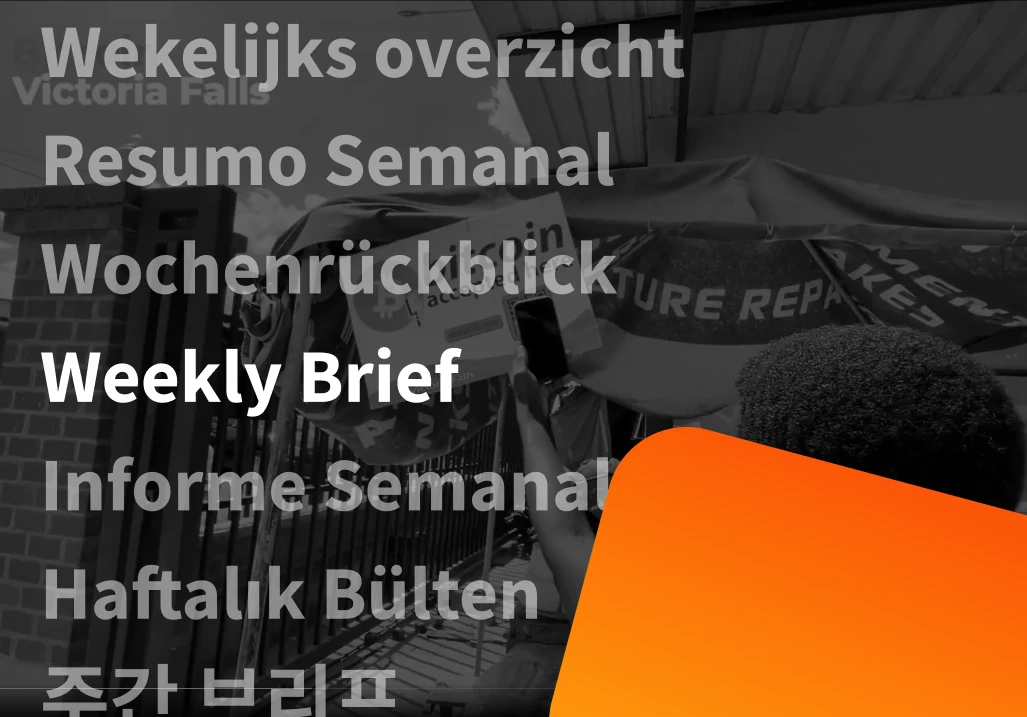
And then there's this: an open-air Bitcoin meetup at Victoria Falls, Zambia — where the Zambezi is the backdrop and the conversation is about sound money. Not every signal is a payment metric. Some are just proof that the community keeps showing up.