BLOG |
Bitcoin LN 101
An interview with independent developer Supertestnet about cutting-edge technology for Bitcoin’s Lightning Network
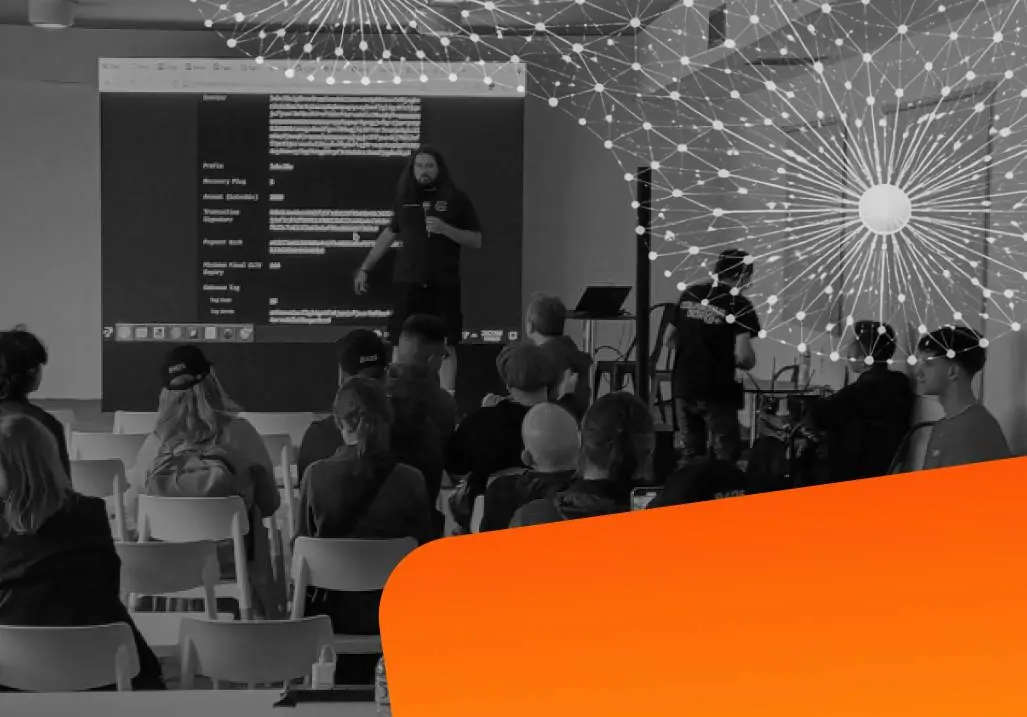


Supertestnet describes himself as a “Bitcoin developer” or “an independent software programmer.” He focuses on “research and development of layer two technologies in Bitcoin, and occasionally layer one stuff. Here, I'm presenting improvements to the Lightning Network.” When Supertestnet says “here,” he’s referring to the 2025 edition of LABITCONF in Buenos Aires, where Blink interviewed him on a sunny afternoon.
In the following conversation, we go into Supertestnet’s newest creations and the philosophy that guides his work. By the end, you’ll probably be perplexed. There’s a chance you’ll also respect this mad scientist’s unusual and refreshing approach to life and coding.
It seemed like Supertestnet spent most of LABITCONF around the Tech Stage. He was always in the area. As a presenter on that stage, Supertestnet explained two of his latest projects. This article will focus on those projects and the stories around them.
The first one was Papa Swaps, a type of submarine swap. This is how Supertestnet explained the general concept:
“Submarine swaps are a way to go between layers through a pair of transactions in the Lightning Network, or on the base layer. So if you have money on Lightning, and you want to go onto the base layer, submarine swaps let you do that in two transactions, or vice versa.”

This is why Papa Swaps are a superior form of submarine swaps:
“Papa Swaps are an improvement over the regular submarine swap protocol because they let you do the same thing in one transaction instead of two. You can go from the Lightning Network to the base layer, or the base layer to Lightning. It also gives it three other benefits: 1.- It is half the cost of a submarine swap. 2.- It is twice as fast as a submarine swap, and 3.- It uses half the block space.”
In the talk, Supertestnet used Muun wallet as an example of a project that would benefit from adopting Papa Swaps. This wallet uses submarine swaps, and it’s famous for being phenomenal when Bitcoin fees are low, but entirely too expensive when they’re high. By using Supertestnet’s Papa Swaps, Muun would cut its costs in half, work twice as fast, and leave a lighter mark on the blockchain.
As a logical next step, Blink asked Supertestnet about his plans for the Papa Swaps. His answer changed our perception of reality.
This mad scientist’s philosophy goes against anything they taught you at school, but hear him out:
“I stay away from commercializing the things I come up with. I just create them, put them out into the world, and share what I figured out how to do at conferences. My hope is that exchanges and wallets and swap services like Boltz Exchange will adopt this technology and view it as an improvement over the current state of the art. And then, the whole network will get better as a result.”
The general improvement of the Bitcoin network is Supertestnet’s reward.

To the untrained eye, that might sound too hippie-dippie, but the fact of the matter is this: if you’re heavily invested in Bitcoin, the general improvement of the network will translate into wealth. Is Supertestnet playing 3D chess while most of us are stuck on a normal checkerboard? His way of thinking does sound stress-free.
Anyway, about plans for Papa Swaps specifically, he told Blink:
“I can't control that, but I've gotten lots of good feedback from the project. Boltz Exchange said that if wallets adopt it, they'll adopt it.”
The other project that the mad scientist presented is even more ambitious: Hedgehog. The Lightning Network has a huge weak point that everybody is aware of, and against all odds, it has managed to thrive despite it. This is how Supertestnet defines the problem:
“Hedgehog is an attempt to figure out a way to improve the thing I like least about the Lightning Network: That I can't send somebody money if they're offline. This is problematic because, for example, if you send me a Lightning invoice and then you go offline - like you put your phone in your pocket and go out to eat or something - I can't pay you. I can try, but my phone will just give an error, because on Lightning, the recipient has to sign all transactions. And if your phone's not available to do that, it just won't work.”
The mad scientist’s solution was to create a protocol “very similar to Lightning,” Hedgehog:
“I looked through the Lighting specification, found the reason for this- what I consider to be a flaw, and then wrote a proof of concept of a Lightning implementation that doesn't have that one thing in it. So, you can send people money when they're offline. I call that Hedgehog, and I presented it and did a demonstration today.”
In Hedgehog’s GitHub, Supertestnet explains the project’s look and feel:
“Using hedgehog feels similar to using an ecash protocol like cashu or fedimint, except with no server. If you have a channel with someone, you can -- without their assistance -- create a payment for them, embed it in a piece of text (think of it like a cheque), and send it to them via email or some other communication method. Then you can go offline. When they get online, they can either accept the state change (the cheque) and update their balance without your further assistance, or they can reject it.”
The explanation reminded us of something Zeus Wallet is already doing, so Blink asked him about it. As it turns out, that implementation was also a Supertestnet original.
This feature was Supertestnet’s first attempt to solve the same problem, namely that you “can't send somebody money if they're offline.” This is how he first did it:
“Zeus Wallet has an optional feature called Zaplocker, and if you enable it, then people who send you money if you're offline, instead of their wallet showing a failure, it'll show something called a “pending payment” or an “in-flight payment.” Then, the recipient has 24 hours to come online and collect their money.”
As you might imagine, the product didn’t completely solve the problem. In fact, it caused chaos among a group of Zeus users and inspired the creation of Hedgehog. The story sounds like a comedy of errors, but it makes total sense and explains the innerworkings of the Lightning Network at the same time:
“However, Zaplocker has a weak point, because it causes a lot of forced closures. If the sender sends a payment and then it goes into this pending state, their counterparty's wallet will force close that channel if the sender doesn't come back online within a certain time period after the payment has been settled.
Let’s say the recipient comes online within 24 hours and settles the payment. If the sender's offline now, then their channel counterparty starts a timer on them and says, "If you don't come back within a certain amount of time, I'm force-closing your channel." A lot of people complained when Zeus implemented Zaplocker because their channels started getting forced closed. It's kind of my fault because I came up with the protocol, so I designed Hedgehog to fix that. If you use the Hedgehog protocol, you don't get a forced closure.”
However, Hedgehog might not be the implemented solution. Why? Because of Matt Corallo’s Lightning Bolt.
When Blink asked Supertestnet about Hedgehog’s present and future, he answered: “No one's using it yet.” We had follow-up questions, but they weren’t necessary because Supertestnet explained, “I don't expect Hedgehog to get adopted. I expect Matt Carollo's specification to get adopted because he's doing it more seriously.” The story also plays like a comedy, but it contains fewer errors than the previous one, and the main character is unexplainable:
“There's a guy named Matt Corallo who's also working on this same problem. He's trying to make it so you can do asynchronous Lightning payments. However, he's not like me. I see something, and I come up with a solution for it, and I build a proof of concept, and I show it off at conferences. I'm like a show-and-tell developer.
Matt Corallo is more serious than I am. He wrote out a specification for it, and he spent about a year and a half getting feedback from Lightning Labs, Core Lightning, and other Lightning implementations. He gets feedback on how to improve his protocol. And now, there's a team of people trying to implement his solution. There's a new BIP… or not a BIP, but a Lightning... what do they call it? A Bolt, a new Bolt for it.”
Mind you, Supertestnet was completely unfazed when he told us this story. There was no jealousy or resentment in his voice, and he wasn’t complaining at all. The man just lives on a different frequency than us mere mortals.

Us mere mortals can still get in touch with Supertestnet. These are his coordinates:
“You can find me on my website, supertestnet.org. Also on social media, on Twitter, I am supertestnet, all one word. On GitHub, I am supertestnet, all one word. On Telegram, I'm supertestnet, all one word. And on Nostr, I'm supertestnet, two words. There's a space between them.”
There’s also his YouTube channel, High Level Bitcoin.
As a closing question, we asked Supertestnet about predictions for the Lightning Network’s future, and his answer was as perplexing as the rest of this interview:
“I think Ark is significantly better than the Lightning Network.I hope Ark replaces it and everyone just starts using Ark.”
Woof! Shots fired.
Start receiving and sending bitcoin now